Thursday, March 29, 2012

Froot? Fruit? Frut?


We used to sneak out of middle school in the middle of the day to go to the little convenience store across the street and get brown paper bags filled with fruit-flavored Tootsie rolls. Called 'em Frootsies. 3 for a nickel, and milk money went a long way.

Now, apparently, I can buy them from CVS by the bagful and don't even have to sneak around. Being an adult is pretty awesome sometimes.

(The vanilla ones are still disgusting.)

Wednesday, March 21, 2012

Gadgetry

First. Go read this:


Done? Good. Now.

There are two things I lust after with a fiery passion. The want ebbs and flows, but I can't kill it completely.

I want a food processor, and I want a KitchenAid.

I don't need these things. I have zero use for them and no room for them, and I know the truth of them: they're a pain to clean and keep in good condition, especially when you don't have a dishwasher. They're impractical for cooking for two people. They, like TVs, never look the same size in the showroom as they do in your home. They would languish in a cupboard.

I grew up in a home with a Cuisinart. My father could probably tell you what he used it for in detail, but the only thing I can remember him digging it out of the closet for was to make breadcrumbs, which can just as easily be made with a mallet or a rolling pin. Despite all its attachments and whirring, it was, or at least is in my memory, a unitasker.

And don't get me started on the KitchenAid - that hunk of motor wouldn't suddenly turn me into a pastry chef, it would just remind me, constantly, that I'm not one. And anyway, I happen to live with a truly fantastic baker who does things with an oven I can't even imagine being capable of. She would look at me in this scientist-y way she does and say, "Yeah. I know how to follow recipes, and you can't," and that's totally true. I can follow a recipe if I have to, but it sucks all the joy out of dinner. I would rather wing it.

Anyway. There is a truth to things kitchen-y which that article touches on but doesn't nail home: you cook the way you cook, for the people you cook for. And while it's certainly true that, over time, the way you cook changes, the reason it changes is because of what you're cooking and for whom, not because of how you're cooking it.

To pick on my father's gadget obsession for just a second more: I will never make pasta frequently enough to buy the custom ravioli molds that have lived in his kitchen drawer for decades, and if I ever did make ravioli from scratch, I'd seal their edges with a fork. The lack of ravioli molds is not the thing keeping me from making ravioli.

But. Angela got me a cast iron wok for my birthday last year and I use it all the time, weekly at least. I didn't suddenly become a stir-frying fiend once I owned a wok, I did it just as much before, just badly - my pan was too small, it tended to heat unevenly and burn, its coating was never as non-stick as it was supposed to be. Now, the stir-frying I do is better because of the tool I've got, and it's more pleasurable - cooking in a wok is about as much fun as you can have working over a stove. It's such a "me" tool, I can't now imagine a kitchen without one.

The point, I guess, is this: if you're going to add to your kitchen, find tools that supplement the way you actually work instead of tools that give you utility you'll never use, and remember that, worst-case, you can always fall back to a knife and a cutting board.

Wednesday, February 8, 2012

Credible Coffee

(Photo: My mornings - black coffee and a hardcopy of the New York Times.
Every day I'm one step closer to turning into my father.)

It feels like a betrayal, somehow, but I just don't have refined taste for coffee. I know when it sucks and when it's good, but it's become so institutionalized that it isn't about the actual coffee anymore, it's about the company selling it to you and about their method. It's like arguments surrounding fast food - you know, instinctively, that McDonald's must go through some ungodly quantity of potatoes every day, but if you start critiquing their fries, at some point you hit a wall and end up talking about McDonald's itself. You can't get past it because there's no real conception among normal people of what an industrial farm looks like, or how the potatoes make it into your hands. I keep trying to picture it, but all I keep coming back to is an image out of Faulkner, hardscrabble and backbreaking labor and bad luck, not machines that can harvest, shuck, and mulch acres at a time.

It's the same thing with coffee; it's always been a means moreso than an end to me, which probably explains why it's taken me til now to figure out how to brew a decent cup of the stuff. It was about time - I was sitting at my desk glowering at whatever just got spit out of the office Keurig and realized, if I was going to be drinking that much of something, I should realistically have more of a hand in preparing it than pushing a button and accepting whatever came out of it.

It turns out it wasn't as hard as I had built it up to be in my head and is more about the water/coffee balance that your beans need to achieve maximum awesomeness than anything else. It's also about being able to articulate and refine what, precisely, it is about coffee you like to help bring that out while de-emphasizing the things you care less about. I learned, though I knew this at some level, that I like lightish roasts and drip coffee, black, in obscene quantities, hot enough to warm my gut but not so hot as to keep me from drinking it fast. Essentially, I like diner coffee that's been cooling in a cup that never seems to empty.

I didn't realize that until I just typed that out, but...huh. Neat.

It's probably all very mundane and individual - talking about coffee is a bit like listening to somebody prattle on about their previous night's dreams - but I'll leave you with this one, tiny thing: apart from the coffee being fresher, more potent, and infused with the tiny bits of ownership and pride that come with being involved with the process of making something yourself, the warm, bubbling, swirling sound my coffee makes being poured from Thermos to cup at my desk at work is so transcendently pleasurable that I actually look forward to it when I'm making it in the morning.

It makes me never want to be near my office Keurig's spitting, kvetching machinations ever again.

Thursday, February 2, 2012

Salad, Bar-None

(photo: Lunch.)

Sandwiches are temples to everything good about eating. So why have I given them up for salads for lunch most days?
  1. I can make 4 day's worth of salads in 10 minutes on Sunday night for the two of us for 10 bucks a person.
  2. I can do it up exactly how I want - that salad above is field greens, turkey breast, red peppers, 2-year-old cheddar and bleu cheese dressing. And it's AMAZING.
  3. I'm always treated to a freshly assembled meal instead of a sandwich that's sat in a bag on the train every day.
  4. Sandwiches should be treated like special occasion food; nothing's quite as sad as a mediocre sandwich.
  5. If I bring the component parts of lunch to work, it's almost like I'm cooking for myself. That's a good thing, and puts me into a much nicer place than grabbing something from the fridge and eating it.
But the biggest thing, and this is something that's slowly changing the way I feel about eating in general, is while I spend most of my time wanting a sandwich, (who doesn't?) I don't actually need one every day. I spend all day in front of a computer - I don't need a truckload of carbs to get me through it. I barely need any, really, and if I'm better about what I eat for lunch, I can go a little nuts when it comes time to cook dinner. It isn't a diet so much as a compromise.

And for the moment, I actually think I'm okay with it.


Tuesday, January 31, 2012

Butcher? I hardly stew 'er! (sorry.)

(photo: one of the many fantastically curious things available at our local butcher.)

Grocery shopping and cooking for a family of two is a pain in the ass when you consider the following.

We, as a unit, in regards to food, are fickle and craving-driven - I could make a stew on Monday night and, while it sounds good in theory to eat it over the course of the week, I know from experience that it will either end up frozen and forgotten until unearthed the next time the power goes out and I'm forced to throw it away, or it will sit in the fridge making us guilty every time I open the door until one of us sneaks off and trashes it while the other is distracted.

That becomes a problem, though, because most recipes are designed around a family of 3 or 4 with leftovers - meatloaf, though tasty, is at the bottom of the list of things I cook because it's an awful lot of work to go through to make a meal that we'll be guilted about not eating, and the more of it is left after dinner, the longer it will be until it gets thrown out. The idea that it's easier to reduce a recipe rather than expand it doesn't take the size of traditional cookware into account. I've been looking for a 2-person meatloaf pan. We'll see what happens with that, but in the meantime I'm stuck.

Even shopping for groceries is a pain - mixes and boxes and semi-readymades serve 3+.

It isn't even a problem that only hits the Rice-a-Ronis of the world - it's impossible to easily get a pound of, say, ground beef, without jumping through hoops. I would routinely end up with 1.5 pounds of the stuff; that's 4ish burgers with a bit left over to turn into an unidentifiable round ball of who-knows-what in the freezer.

But then I realized something sort of fundamental: we're homebodies. We don't spend a lot of money outside the house, and if we do, we work hard enough during the week that the idea of going out on a Wednesday night is laughably optimistic. We live in a reasonably priced area, we make enough to support ourselves, and no matter what we would spend on the necessities to cook at home it's way, way cheaper than eating out. Cooking for 2 and never having to worry about leftovers takes more time out of my day, but it's time I'm happy to spend because me and food and cooking, we're buddies.

So (and this is the whole point to the thing) we started going to a butcher. It was the logical next step after realizing that the time spent cooking wasn't wasted, that it was recreational, and that I might as well know where my groceries were coming from, more or less.

It was also a relationship gesture - when you go grocery shopping for the week, you can't split the bill without it being awkward. This way, I got to take on some of the financial responsibility.

I was expecting to take a financial hit from this tentative arrangement, but in actuality the quality of our meat went up while our outlay decreased. It ends up cheaper because I can ask for a pound of stew beef and get (and pay for) exactly that. I can get a one pound, 50/50 split of ground round and chuck and not have to pay for leftovers I probably won't use.

This Sunday I picked up 2 huge (HUGE!) store-made linguica, a chicken breast on the bone and, as mentioned above, a pound of hand-trimmed stew beef and a pound of excellent ground beef for $17. The exact quantities of that at the grocery store would have cost me a bit less, $12 or so and at a lower quality, but those quantities weren't easily available. I would have paid $20, potentially a bit more depending on what was out, used as much as I did from the butcher over the week and eventually discarded the rest.

Moral of the story: support your local businesses.

Monday, August 24, 2009

Eggamuffin

There's a whole list of foods that thrive off of indifference. For example: gyros. The more care and concern and love you put into a gyro, the worse it gets. You can make your own cucumber dressing, you can make your own pita bread, you can spend hours making a sandwich that, when all's said and done, still isn't anywhere near as tasty or as cheap as the guy standing behind the greasy cart in front of your office building could have made you in 30 seconds. Your gyro guy is able to do that because he's probably made a lot of gyros in his day and he's to the point where he doesn't actually have to think about it all that much. He's in the zone.

Okay, I might be mythologizing the grease truck guy a little, but the point remains: Some foods taste better without care and attention. Some foods taste better when the guy at the griddle is doing a half-dozen breakfast-related things simultaneously. Some foods have been reduced to the bare minimum steps required to make them both tasty and fast and there aren't many places to take them anymore.

Diners are cathedrals to indifference food.
...but corner delis are the storefront churches where the miracles happen.

It's taken me some time to get to the point where I can make a ham (or bacon, or sausage, or whatever) egg and cheese sandwich that tastes right to me - it became a bit of a priority once I moved out of the deli capitol of the world and had to start making my own breakfasts again. I guess I just...stopped worrying about it.


Ingredients:

1 bagel/roll/croissant, etc.
1 egg, beaten fast but not too much
2 slices sandwich ham
1 slice American cheese
1/4 tablespoon butter

salt
pepper


Don't need a thing more than that. You're in a rush, right?

Put the ham in a dry frying pan and put it over the stove on medium. Leave it until the bottom of the ham chars a little (3-4 minutes), flip it over and repeat (2-3 minutes). set aside. That was your prep work.

Put your bagel (or roll, or what-have-you) in the toaster.

While the ham is grilling, beat the egg and pull the slice of cheese out of the fridge. You're going to have to do the bit coming up a little fast.

In the same pan after the ham's been removed, melt the butter just until it starts to bubble. Your pan should still be hot and over medium, so that shouldn't take more than a few seconds. Make sure the butter has touched the whole bottom of the pan.

Pour in the egg. It will start to cook as soon as it hits the pan. Once the egg has solidified and started to seriously cook (30 seconds or so) flip the egg with a spatula, or, if you're fancy, with a flick of the wrist.

This is the part that requires a little bit of speed and coordination. You should have a circle of egg in your pan. Put the cheese on top of the egg with one side of the cheese touching the edge of the circle, and put the ham on top of the cheese. Fold the egg in half on top of the ham and cheese, then in half again. You should end up with a wedge of egg/cheese/ham/egg/ham/cheese/egg. Put it on a bagel, throw some salt and pepper (and ketchup, if you're me) on it and dig in.

Don't worry about cooking the ham, it's cooked long before it gets to you. Don't worry about melting the cheese, either, the egg will do that for you once it's all on one bun. And coffee - don't forget the coffee.

Tuesday, August 18, 2009

Baconation

From the "don't knock it 'til you've tried it" department, I wanted to highlight one of my favorite sandwiches of all time: a toasted poppy seed bagel with cream cheese, scallions and bacon. It isn't exactly a light breakfast - it hits your heart like a mallet - but, um...

I was going to try to defend it, but let's be honest here:
you're topping cream cheese with bacon and furthering the injustice of it by sprinkling it with just enough green, leafy material to highlight how completely insignificant that green, leafy material is considering what it's sitting on top of. This shouldn't be a daily thing, is what I'm saying. It's a treat, a Thursday morning pick-me-up, not a Dunkin Donuts, pulled-up-to-the-drivethru-and-realized-you-don't-know-what-you-want afterthought.

I like sandwiches that dance, and this one's got potential. It's salty, but not crunchy-salty, sweet, but not tongue-smackingly so and just a tiny bit earthy and gently bitter, but still lighter than a classic deli bacon egg and cheese, and much faster to make. Everything in it needs everything else: ham doesn't work, and it has to be a bagel, and incidentally? It tastes better with sweet, creamy tea, not so much with coffee.

Friday, July 31, 2009

Now THAT'S what I call garlic!

I'm generally of the 'laws-and-sausages' school of writing about food in that I don't particularly care for process photos. Step-by-step photos about dinner seem to say, more than anything else, "these are some beans. These are some beans in a colander. Here are some other beans." like Patty and Selma's vacation slides, and that just ain't my style.

All that said, you gotta see this.
Penny included for scale.

That is one hell of a garlic clove, a b-movie monster-sized foodstuff, and it tasted nothing like its more common cousins (it came in the CSA box this week). It was sweet and just slightly tangy without any of the oily bitterness that can accompany garlic. It's mild, too, mild enough that I threw that whole clove into the recipe below and didn't end up backing away in fear of my own breath once I had to eat the stuff. It was the shallot of garlics.
...and it was great in the Mexican-inflected rice I threw it in, though in retrospect a pasta with cream sauce would have let it shine better. Maybe next time - we've got more of it.

In any event.

Ingredients:

1 cup brown rice
2 1/4 cups water
1 tbsp olive oil
1/2 tsp salt

1 huge sweet garlic clove, chopped coarse
1 1/2 cups raw corn
1/2 cup green onion
1 tomato, diced

1/2 tbsp butter
1 tsp crushed red pepper
1 tsp parsley
1/2 tsp yellow mustard powder
1/2 tsp cayenne pepper
juice of half a lime, halved
salt and pepper

The Gist:

I used our rice cooker for the rice because rice cookers are awesome, but a saucepan with a lid works fine. put the first four ingredients in the saucepan, heat until boiling, cover, and simmer until done. You may have to play with the water content - slightly less that 2 1/4 cups seems to be perfect for the brown rice we usually have around, but it can vary.

After the rice is halfway done (20-25 minutes or so, but be careful) heat the butter over mediumish heat in another pan until it bubbles. add the rest of the ingredients except for the tomato and half the lime juice. Cook slowly, keeping it moving, until the corn is tender and the garlic smells awesome. Add the tomato and remove from heat. Tomato is delicate and you want it to warm, not cook and dissolve.

When the rice is done, put it in a large bowl, add the other ingredients and mix it together with a spoon. Add the rest of the lime juice and serve.

1 cup of brown rice turns out to be a lot of rice once you add all the other stuff to it - this quantity will serve 3 as a meal unto itself. As a side, probably closer to 5. It's good with shrimp and sour cream, too, but what isn't.

Friday, July 24, 2009

Big Shrimpin'

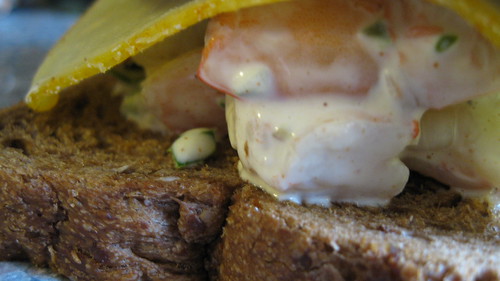
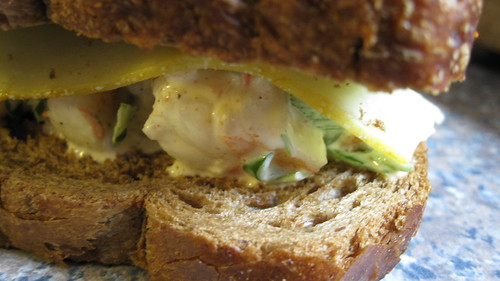
Made lunch today and was pressed for time (still am) and didn't feel like digging through the fridge for all of the "right" ingredients, so I grabbed the first few things I saw from the CSA shelf and chucked them into a bowl with some cut-up shrimp.
It turned out really well.

That's shrimp, green onions, (the last of the) garlic scapes, mayo, lemon juice, paprika, and black pepper on toasted pumpernickel with (the last of the) muenster. Very light. Lean a little heavy on the lemon juice, no extra salt, light on the pepper. The muenster was just a bit too strong; sharp provolone would have been better. It would be good next to a bowl of soup, I imagine.

Thursday, July 9, 2009

Slaw Disposal Method 1

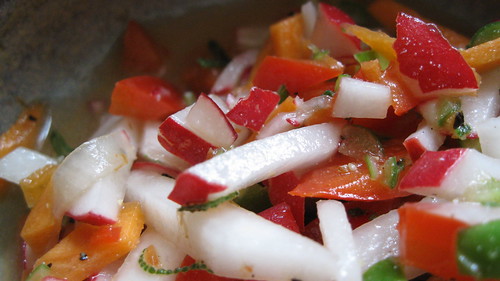
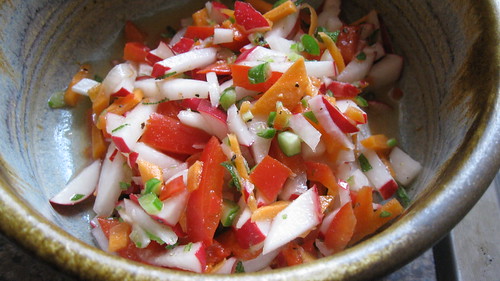
It didn't occur to me, though it probably should have, that having too many radishes to eat in a week and turning those radishes into slaw would inevitably result in having too much slaw to eat.
...So I've been putting it on pretty much everything. For the record, that's turkey, muenster, slaw, cucumber and mayo piled onto rye, and it was epic.

Next, I'm thinking omelets.

Tuesday, July 7, 2009

Radish Slawghter

We joined a CSA this year. It was a practical choice, for the most part - our vegetable intake was a bit on the low side and our preferred supermarket, while being awesome-cheap for most things and having generics that blow their name brand competitors out of the water in price and, shockingly, taste, is a bit hit-or-miss when it comes to produce.

This hasn't been a good summer for Massachusetts agriculture so far. Too much rain and not enough sun means all sorts of normal summer crops are behind schedule (no local corn yet and no tomatoes) while green leafy things are doing just fine. With our first CSA box last week, we got some lettuces and peas and other tasty things, along with a gigantic mess of radishes, and how many radishes can two people realistically eat? CSAs are the Right Thing To Do, I think, but they're also expensive - you get what you pay for but you get a lot of it, and every last bit thrown away because you can't find a use for it or forgot about it in the crisper (sorry, arugula; sorry Farmer Dave) hurts a little.

The other thing about CSAs is, we went into it thinking we were going to save money off of our weekly grocery trips because we wouldn't have to buy as many vegetables. That might be a little true, but realistically we just end up eating more vegetables - we're eating healthier, not cheaper.

Anyway. What do you do when you have radishes coming out of your ears?
Make slaw out of them.

This recipe might not be to everybody's taste - I'm pretty easy-going, food-wise, but I'm overly picky about slaw, about water content and texture and cut and...I get excitable in diners, is what I'm saying. Also, there's no cabbage in this slaw, mostly because I didn't get any from the CSA this week, but there ARE garlic scapes in it because I did get those. Throw a little bit of garlic in it if you'd like and if you don't want to go scape-hunting, but don't overdo it.


Ingredients:

(I did this by eye - you know what slaw's supposed to look like, right? Keep adding stuff until it's the right combination of colors. I've listed the ingredients relationally with a basic idea, but your gut's probably a better guide. The recipe itself is a modification of this one from myrecipes.com.)

Salad:
1 cup Radishes, rough cut in slivers
1/3 cup bell pepper, chopped
1/2 as much of the bell pepper as Carrot, rough cut in slivers
1/2 as much of the bell pepper as Garlic Scapes

Dressing:
2 tbsp vinegar, any will do, I used Apple Cider Vinegar
1 tsp Sugar
2 leaves fresh Sage, slivered
1/2 tsp Olive Oil
1/4 tsp Mustard Powder
generous twists of Salt and Pepper

The Gist:

You can use a food processor for this, but I don't - hand-cut ingredients in slaw makes it less paste-like and less uniform. It shouldn't take long to cut your veggies by hand.

Combine the salad ingredients in one bowl and the dressing ingredients in another. Whisk the dressing and pour it over the salad. Refrigerate for 15 minutes or so and serve. The quantities above will serve 2 people as sides or 4 on sandwiches. Personally:
...I like it with bacon and muenster and a little bit of mayo on wheat.

Friday, June 5, 2009

Is That a Zucchini in Your Pocket? Thought So.

Angela and I don't see each other much during the week but I don't work Fridays, and Fridays are for dinner-for-two. Recently it's been pizza and beer because, really, who wants to cook at the end of a long week, but now that we've settled more or less into our new apartment and now that our kitchen is (comparatively) frikkin huge, I'm starting to cook again. Also, there's nothing good on TV during the summer. Ahem.

(For those of you keeping score, that was my off-hand explanation as to why I haven't posted in 6 months. Sorry about that.)

I was raised in a household were every meal was balanced, even if balance meant burgers and fries and a salad. I have very few active dislikes from the vegetable kingdom, cauliflower being the big one, the I-don't-care-how-much-cheese-you-put-on-it, I'm-not-eating-it one, and that's more of a texture issue than anything else - eating cauliflower is like chewing on brined tree bark and I want nothing to do with it.

And despite the fact that I'll eat practically anything, there are some vegetables that, for whatever reason, weren't around when I was growing up. Zucchini was one of them - I had a habit of confusing zucchini and cucumber until embarrassingly recently because, hey, they're both green and phallic and waxy and I couldn't for the life of me remember a situation where I had the two at-hand at the same time to reenforce their differences.

Laugh if you want, but I guarantee if you think about it, you've got a similar hang-up that "normal" people (not me; I'm a gentleman) think is batty.

Anyway. Summer's here, and summer means good produce, and good produce means I can throw a little of the balance that's been lacking in our diets back into the rotation.

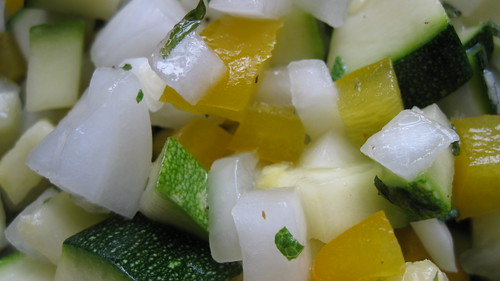
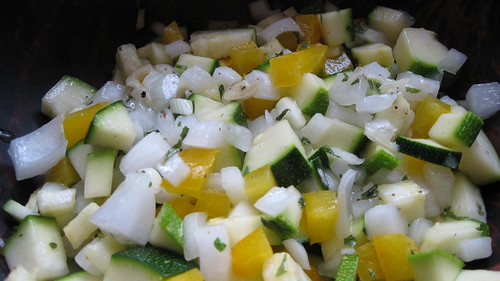
We had zucchini in the fridge and I needed something to go along with the pork chops (Yes, pork chops. I'm still me, after all) and this:
...is what I came up with. It's a zucchini salad, light and crisp and hassle-free in the extreme. It helps to have a whiskey barrel filled with herbs outside, but if you don't have any fresh green leafy things lying around, use dried ones. You're not going to be cooking this (although you can if you want to; see below) so the balance may be tricky to pull off.

Give it a whirl.

Ingredients:

1/2 zucchini, cut into bite-sized pieces
1/2 onion, chopped
1/2 bell pepper, ideally something colorful and over-sweet, chopped
1-2 cloves garlic, chopped
Juice of 1/2 lime
olive oil
Parsley, a heavy pinch or two should do
Fresh sage, 2 leaves, chopped
kosher salt and freshly ground black pepper

The Gist:

This is so simple it's ridiculous - take those ingredients, put them in a bowl, mix them up by hand and put it in the fridge for a bit. Tada! Salad.

If you're more in the mood for a warm vegetable, heat some oil in a pan, toss the salad in and cook it until the zucchini is cooked through. Or bake it. Or stir fry it. It really is a versatile collection of ingredients - it'll turn into whatever you want it to after the application of a little gentle heat.

Considerations:

I don't tend to get specific about salt and pepper, but here (like on any salad) freshly ground pepper and kosher salt make a difference - you want them to stand out instead of blending in with the background.

Monday, November 24, 2008

The Devil You Know

I didn't think I liked deviled eggs. I didn't have a reason really, except that they had been categorized in my head next to the other foods that seemed to surface at holiday parties my grandparents threw when I was a kid that I refused to eat - pickled beets in particular. There was something about the consistency of the eggs, slimy whites and chalky yolks, ice cold and impossible to pick up, let alone eat, that didn't do much for me.

That was 20 years ago, and I figured not long ago that I should give the things one last shot. I'm glad I did, because in the process I found yet another use for one of my favorite things: pastrami.

When I broached the idea of putting meat into deviled eggs to some friends at a get-together I threw a few weeks ago, they reacted with universal...let's call it suspicion, though it might've been closer to disgust. It isn't that weird an idea, though - hard-boiled eggs have been intrinsically paired with ham for years and years and pastrami, though not a pork product, shares a lot of the same characteristics with ham while being a little subtler, a little spicier and slightly less versatile.
This recipe is perfectly tasty without the pastrami though, so leave it out if you must. Keep in mind, though, that you might have to increase the quantity of salt to compensate.

Ingredients:

  • 6 Eggs
  • 1 heavy pinch of salt
  • 3-4 slices deli pastrami, chopped
  • 1/2 tbsp butter

  • 1/2 handful Green Onions, chopped
  • 1 tbsp Mayo
  • 1 tsp Dijon Mustard
  • 1/4 tsp Lemon Juice
  • 1 tsp Tabasco
  • Salt and Pepper to taste
  • Paprika
The Gist:

Hard-boil the eggs. There are as many ways to this as there are people who make them, but I actually like Emeril's method - cover the eggs with water in a pan, bring them to a boil over medium heat, boil for 2 minutes, remove from heat, cover, and let sit for 11 minutes before cooling and peeling.

Fry the chopped pastrami in a pan with the butter until crispy while your eggs are cooling.

Cut the hard boiled eggs in half lengthwise and remove and reserve the yolks in a bowl. You can use a spoon for this but if you're careful and if the eggs are cooked just right, you can pop the yolks out of the egg halves with your fingers without damaging the whites.

Mash the clumps out of the yolks with a fork. Add the rest of the ingredients and mix well. Spoon the yolk / mayo mixture back into the yolk shells, dust with paprika and chill in the fridge until serving.

Tuesday, November 18, 2008

Hot Potato

Of all the foods in the diner breakfast pantheon, it's hash browns that deserve more attention; what with bacon hogging the spotlight (looking back, that's a truly awful pun; sorry about that), even sausage has been relegated to the background, coming to prominence only infrequently on things like biscuits, but the minimal attention paid to sausage puts it on the C-list compared to the scoop-it-off-the-grill-and-forget-about-it nature of breakfast potatoes.

Potatoes have, in general, been stuck at the side of the plate for too long, which is a shame considering all the tasty things you can do to them - they're even good boiled, a fate I wouldn't usually reserve to the blandest of foods.

To hell with that, I say. Attention must be paid to potatoes, and breakfast is as good a place as any to start.
The diner breakfast trifecta is familiar the country over - eggs on one third of the plate, meats on another third and potatoes on the remaining third. This recipe brings the starch to the forefront by putting it smack-dab in the middle of the plate with everything else catering to it, for once. You'll notice that the proportions are similarly balanced in the potatoes' favor as well.

Ingredients:

  • 1 mediumish potato, cubed
  • 1/2 onion, diced
  • 1 tbsp olive oil
  • 1 tbsp butter
  • Pinches of Rosemary, Parsley and Thyme
  • Dashes of Paprika and Celery Salt
  • Salt and Pepper
  • 1 Egg
  • 1 tbsp half-and-half
optional:

  • 1 cup (or so) sliced smoked hot Chorizo
  • 2 dashes of Louisiana hot - Frank's, etc.

The Gist:

Melt the butter in a pan with the olive oil over medium heat, and throw in the potato and onion once the butter is bubbling. Toss to combine.

Potatoes are hardy starches - you're going to have to cook them for awhile at a relatively low temperature to simultaneously cook them and keep them from burning, about 10-15 minutes should do it. Add the spices and chorizo (if you went that way) halfway through - if you ever wondered what makes diner hash browns that distinctive slight-orange color, by the way, it's the butter and the paprika.

Once the potatoes are cooked, beat an egg with the half-and-half, pinches of salt and pepper and, if you like, the hot sauce. Pour into the pan directly over the potatoes and tilt the pan around for an even distribution. Don't touch it after that, just let it cook for 3 to 4 minutes. The eggs will be cooked through but slightly soft on one side, the potatoes will be fork-tender and the sausage will be warm and slightly crispy.

Serve with coffee and, if you think you can deal with the added starch, toast.

Notes:

  • Chorizo translates to "sausage," but in practice (in the United States at least) Chorizo is almost always sold smoked, not raw. If the chorizo you have is raw, you'll need to cook it first.
  • Sour cream can be substituted for the half-and-half. So can water; it's just a stretching agent.
  • And speaking of sour cream, it works wonders here as a garnish.
  • So does grated cheddar.
This recipe results in a diner-sized portion - I can eat this much by myself without so much as blinking, though you could probably feed two normal people with it. If you're cooking for two hungry people, add another egg and you should be fine. I serve it on one plate with two forks, but that's me.

Friday, November 7, 2008

Hiatus?

Sorry for the lack of posting recently - Angela was in Europe for two weeks and the camera was with her, and the pics-or-it-didn't-happen nature of food blogging kinda defeated the purpose.

She's back. Expect some tastiness soon.

Monday, October 6, 2008

Would you, could you, in the rain?

Angela's parents came over to visit this past weekend and I went into a bit of a panic - she thought it was no big deal: just clean to parentally-acceptable levels (which aren't that far from the everyday anyway) and make sure we have seltzer in the fridge. Sounds great in theory, but I started worrying about the menu.

Visits to my family revolve around food - before I've even got my bag off of my shoulder after walking through the door to my parents' apartment, my father starts talking about what's in the freezer, or marinating, or left over from last nights' dinner. For me to show up at a family member's house without there being food (or at the very least, beer) on the table is unthinkably foreign.

All sorts of equivocating on my part went into the thing, but the long and the short of it was, we ended up getting an eight-pound ham and went out to a diner for breakfast anyway. The diner was the plan from the beginning (I had missed that part) and the ham was on sale.

Even when you discount the bone, eight pounds is a lot of ham. The bone will go into split pea soup but the trimmed meat is going to be making its way into pretty much everything this week - sandwiches, pasta sauces, mac 'n cheese, but the most satisfying addition to me is to scrambled eggs.
I don't want to annoy the bacon lovers in the audience but eggs and ham, green or not, match better on a plate than bacon and eggs do - the ham negates the need for both salt and pepper at the table, melds better with onions and cheese, and can be fried in butter without going over the top. Plus, you can cube it; try that with a slab of bacon.


Ingredients:

  • 1 1/2 cups cubed ham
  • 3 eggs
  • 1/4 cup shredded american or cheddar cheese
  • 1/4 cup chopped onion
  • 2 tbsp cream or milk
  • 2 tsp butter
  • Splash of hot sauce (Tabasco or Louisiana Hot)
  • Green onions to garnish
The Gist:

Melt the butter in a pan over medium heat. Add onions and ham and fry until both are lightly browned.

Scramble the eggs in a bowl with the milk or cream; add to the pan. Tip the pan back towards you and scrape the egg away from you so it keeps moving over the heat, cooking slowly. Be patient. Add hot sauce and cheese as you cook the eggs. Keep it moving until the eggs are almost but not quite cooked through and plate immediately - they'll finish cooking on the plate. Top with green onions.

Serve with toast, orange juice and coffee or, if you're like us, just plop the thing down on a table and stick a couple of forks in it. Serves 2 if you feel like sharing.

Thursday, October 2, 2008

Thatsa Spicy Meataball

At the risk of giving up every Italian grandmother's secret, I need to tell you: there's nothing magical about pasta sauce. The memories associated with it, sure, I know the drill: giant copper pots, wooden spoons, big bunches of herbs, clouds of steam whenever lids are lifted, but the ingredients themselves are almost always the same no matter who you ask. The food is secondary.

Just because it isn't magical, though, doesn't mean that there isn't a trick to it. I admit that there's a trick to my pasta sauce just like everybody else's but it's something more fundamental than a pinch of sugar, a dash of hot sauce or using sweet basil instead of regular basil: instead of using large amounts of different kinds of ground meats, I use a combination of lean beef, fresh spinach - tomatoes are nice by themselves and all, but a real meal needs vegetables in it, preferably green ones - and mushrooms: there's something about a spinach-mushroom combination that satisfies my stomach almost exactly the same way meat does. It's textural, definitely, but beyond that I can't say.

I should probably warn you before you start clearing out space in your freezer that I don't make sauce by the gallon, either - I used to do that until I realized two things: that, not having an Italian grandmother's genes coursing through my veins, I just don't eat that much pasta and sauce and that, while this sauce is great on pasta it's awful on pizza - pizza sauce is a base not a main attraction, and needs to be salty, finely textured and mostly ignorable. Pasta sauce, on the other hand, needs to weigh down your fork and doesn't need to be spread over much.
This recipe will feed 3-4 depending on if anybody wants seconds. It's also horribly imprecise because grandma did get one thing right - you need to be adding spices a bit at a time until it tastes right, and it's a pain to measure. I've made it as easy as I can.

Oh, and making this vegetarian is a snap: just replace the beef with another handful of spinach. It tastes fantastic either way.

Ingredients:
  • 1 small yellow onion, diced
  • 2 cloves garlic, coarsely chopped
  • 1 tbsp olive oil
  • 1 small can tomato paste
  • 1 regular-sized can diced tomatoes
  • 1 cup water
  • 6-8 oz. 93% lean ground beef
  • 2 big handfuls fresh leaf spinach, stems removed
  • 1 big handful sliced mushrooms
  • 1 tsp white sugar
spices:

Largest amounts of:
  • oregano
  • thyme
  • garlic salt
  • paprika
  • parsley
Smaller amounts of:
  • red pepper flakes
  • cumin
  • celery salt
  • cayenne pepper
  • basil
The Gist:

You'll need two medium saucepans. In the one, combine the tomato paste, the diced tomatoes, the water, the sugar and the spices. put over low heat to simmer. In the other, saute the onions and garlic in the olive oil until translucent. Add the beef and cook through. There shouldn't be much grease in the pan; add the contents to the sauce pot and stir to combine.

Steam the spinach with water and a little bit of olive oil in the pot that used to have the beef in it over medium heat until it has halved in size, about 5 minutes. Add it to the sauce pot.

Saute the mushrooms in a little bit of olive oil in the same pot over medium heat until they give up their moisture, about 5 minutes. Add them to the sauce pot.

Cook the sauce over low heat, stirring occasionally, until you're ready to serve. Spoon over pasta and top with grated Parmesan cheese.

Tuesday, September 30, 2008

Currying favor

So I opened the cabinet to see what I could do about dinner and realized that, while we had come in under budget this week when grocery shopping, we had missed a few things. Important things like meat.

That's not strictly true, of course - the butcher's department is my favorite part about grocery shopping and a trip to the market isn't quite fulfilling without some quality time spent poking through the ground beef trying to find the elusive packages of 90% lean (perfect for burgers - 85% is too fatty and 93% doesn't have enough fat to taste like anything much) but the chicken breast we picked up I had already boiled for sandwich meat for the week (more on that in a couple of days), the shrimp vanished Saturday during a cocktail sauce experiment and the stew meat had ended up in a fantastic chili on Sunday night.

Change of plans, then - I went about seeing what I could do to clear out the fridge.

- - -

I have one memory of preschool, and that's of celery sticks with peanut butter or cream cheese in the middle. I could have sworn it was a family thing but when I mentioned it in passing to my father he steadfastly claimed to have never heard of such a thing. Despite the pleasantness of the memory, I'm not a big fan of celery unless it's served next to a heaping pile of buffalo wings or boiled to hell and back in a soup. Something about the texture rubs me the wrong way.

Why do I mention this? Guess what caught my eye when I opened the fridge - celery with an inch of life left in it, and a jar of peanut butter on its last legs. Ah well.

But then I got to thinking: Celery goes with peanut butter. Peanuts are used heavily in Thai food. Thai food leans heavily on curry. Curry is all spices and time, I've got plenty of both and I hate, absolutely hate, wasting food.

So here you go -
- a simple peanut and celery curry. It's hot enough to make your skirt fly up and it goes really, really well with a nice, slightly bitter beer (which, conveniently, I've also got in the fridge.)

I love it when a plan comes together.

Ingredients:

  • 3 celery ribs, roughly chopped
  • 1 small yellow onion, roughly chopped
  • 2-3 heaping tbsp peanut butter
  • 2 tsp salted butter
  • 1 tsp olive oil
  • 1 tsp minced garlic
  • 2 cups broth; I used chicken, though vegetable would work fine, too
  • 1 tbsp curry powder
  • 2 tsp brown sugar
  • 1 tsp cumin
  • 1 tsp chili powder
  • 1 tsp dry yellow mustard
  • 1 tsp paprika
  • 1 tsp white pepper
  • 1 tsp black pepper
  • 1 tsp dried parsley
  • 1/2 tsp tarragon
  • 1/2 tsp cinnamon
  • Salt to taste
optional:
  • 1/2 cup toasted pine nuts (I had them left over from a pesto gone wrong, so I figured what the hell)
The Gist:

Lightly brown the celery, onion, and garlic in the butter and olive oil in the bottom of a stock pot with a pinch or two of salt. Add the broth, the peanut butter, the pine nuts if you went that route, and the spices. Heat slowly over medium heat, stirring frequently, until it starts to bubble. Keep stirring for a minute or two - the peanut butter is going to take some elbow grease to mix in completely.

Once it's all combined, cover and reduce heat to low. Not medium-low; practically nonexistent low - the peanut butter is going to slowly sink to the bottom of the pot and if it's too hot it'll burn.

The longer you simmer it the better it will taste, but keep an eye on it and stir it every 15 minutes or so. It'll be done in 45 minutes, tasty in 60 and fantastic in 90.

Serve over rice. Feeds 3-4 people depending on their love of curry.

Monday, September 29, 2008

Fry me to the moon

We thew a little get together this weekend, nothing fancy - chili and beer and, once things got rolling, some deep frying action. The chili was pretty damn good but it's going to take some time for me to figure out what the hell I did, so in the interim: French fries.

Deep frying has a bad rap, deservedly so from a heath perspective, but come on. Nothing is tastier on a late spring afternoon than a burger with homemade fries.

This is my father's recipe, which is probably as simple as you can get. The equipment, however, is less standard but pretty damned important. so here goes.
You'll need a large pot with high vertical sides to keep the oil in. You'll also need a thermometer, a metal slotted spatula or metal tongs, paper towels and a small pile of newspaper or, failing that, more paper towels.

Some notes on this stuff: Cast iron is best because you're going to be heating the oil to a very high temperature and cast iron stands up to that best, though the size is more important than the material. You'll need a multipurpose kitchen thermometer - a meat thermometer won't do you any good because most of them only go up to 200-something degrees Fahrenheit and that's not gonna cut it. And you'll need a metal slotted spatula because the slots will let the excess oil out and the metal won't melt in the oil. You'll also need some frying oil (corn, vegetable or peanut, not olive. Olive oil will burn before you get it to a high enough temperature) and, I guess, some potatoes.

Skin your potatoes if you want (I don't), slice 'em how you want 'em and leave them in a bowl of ice water for 45 minutes or so - this will wick away some of the potatoes' starch and make 'em crispier when they actually go in the oil. Pour about three inches of oil into your pan, and heat it to 325F over medium-high heat. Don't crank it all the way, as you want to make sure it heats relatively evenly. You don't have to stir it, but keep an eye on it. Its temperature will rise exponentially, so start getting ready when it hits 300 degrees fahrenheit or so.

heating oil always scares me, and it damn well should scare you. It's probably obvious, but for the record (again): be careful. hot oil can cause serious damage to you, to your pets, to your children and to anything else it comes in contact with. Don't ignore it and stay clear and please, for the love of all things holy, keep your utensils clean and dry - clean so that whatever might be stuck to them doesn't contaminate the oil and dry so the oil doesn't spit when you're fishing around for the potatoes.

There are some tricks to knowing when the oil's ready if you don't have a real thermometer, but most of those, like flicking some water (or, if you're my father, spit) into the oil to see if it bubbles on contact, are imprecise or gross. Those tricks are good at telling if the oil's hot enough, but bad at telling if it's too hot - overheated oil will burn the outsides of your fries before the insides are done, and it's best to avoid that. It will also smoke, which is an eye irritant even if you can't actually see it in the air.

Once your potatoes have soaked and your oil's at the right temperature, pat them dry with a paper towel and gently slide them into the oil. They'll spit like mad, so stand back. You're going to have to do this in batches to make more than a single serving of fries, but you're not cooking them for that long and you'll get into a groove fairly quickly. Fry the potatoes for 4-5 minutes, turning frequently. When they've reached a golden-brown (which can be hard to judge right, but you'll get the hang of it) pull them out.

You're not done yet: the trick to good fries is to fry 'em twice. Crank up the oil's temperature to 375F. Once it's there, drop your fries back in for 2-3 minutes. The second frying will crisp the outsides of the fries to keep 'em from getting mushy. Pull them out and drop them into a thick rolled up cone of newspaper or into a wooden or metal (not plastic) bowl lined with paper towels. The newspaper will absorb the surface oil without pulling the oil out of the centers of the fries, leaving them moist.

Salt prodigiously and serve immediately. A potato and a half will comfortably serve one person as a side, double it otherwise. Multiply as required. And if you have a massive coronary, it ain't my fault.

(If this looks familiar, a different version of this was originally posted here.)

Friday, September 26, 2008

Chicken Week, Days 3-5: I blew it.

I tried to make the chicken last a week, I really tried, but two things came around and bit me in the ass: chicken bones and a bored palate.

The bones were totally my fault - it turns out, if you boil a chicken down to a shreddable consistency, you're going to end up with teeny, tiny little bones in every bite that, because they've been floating around in hot water for hours and hours, don't crunch so much as get gooey and melt. It isn't appetizing; after day 3 (I made fried rice, sorta, pictured above, which looked much, MUCH better than it tasted), and prodded by Angela with the suggestion of dinner and a movie (a suggestion I latched onto with an inappropriate degree of force) I decided to let the experiment die.

The bored palette, well. I should've known it was going to be an issue. Angela was fine with it, but I got fed up halfway through dinner on Wednesday and made myself a sandwich. Game over, man.

I did learn a couple of things, though:

  1. A whole chicken is fine to eat but a mess to boil. Next time, I'm getting a breast instead - its edibile bits-to-structuring ratio is much more acceptable, the cost isn't too much different if the breast is on sale and you make a portion of that back by not having to deal with the bones and whatnot.
  2. Likewise, boiled chicken breast makes for amazing sandwiches, and a bunch of them - that chicken breast made 6 lunches which is better than I usually get with a pound of meat from the deli - its texture helps fill out a roll better, or something.
  3. Shredded dark meat, if you're not going to eat it right away, gets a paste-like consistency in the fridge if you let it sit for a day or two. It's still perfectly safe to eat but the individual strands of meat start congealing. I'm big on pleasant textures and that wasn't one.
So that's it for that experiment. The next time we decide to play it cheap, I'll do some planning. Maybe.