Showing posts with label Vegetarian. Show all posts

Friday, July 31, 2009

Now THAT'S what I call garlic!

I'm generally of the 'laws-and-sausages' school of writing about food in that I don't particularly care for process photos. Step-by-step photos about dinner seem to say, more than anything else, "these are some beans. These are some beans in a colander. Here are some other beans." like Patty and Selma's vacation slides, and that just ain't my style.

All that said, you gotta see this.
Penny included for scale.

That is one hell of a garlic clove, a b-movie monster-sized foodstuff, and it tasted nothing like its more common cousins (it came in the CSA box this week). It was sweet and just slightly tangy without any of the oily bitterness that can accompany garlic. It's mild, too, mild enough that I threw that whole clove into the recipe below and didn't end up backing away in fear of my own breath once I had to eat the stuff. It was the shallot of garlics.
...and it was great in the Mexican-inflected rice I threw it in, though in retrospect a pasta with cream sauce would have let it shine better. Maybe next time - we've got more of it.

In any event.

Ingredients:

1 cup brown rice
2 1/4 cups water
1 tbsp olive oil
1/2 tsp salt

1 huge sweet garlic clove, chopped coarse
1 1/2 cups raw corn
1/2 cup green onion
1 tomato, diced

1/2 tbsp butter
1 tsp crushed red pepper
1 tsp parsley
1/2 tsp yellow mustard powder
1/2 tsp cayenne pepper
juice of half a lime, halved
salt and pepper

The Gist:

I used our rice cooker for the rice because rice cookers are awesome, but a saucepan with a lid works fine. put the first four ingredients in the saucepan, heat until boiling, cover, and simmer until done. You may have to play with the water content - slightly less that 2 1/4 cups seems to be perfect for the brown rice we usually have around, but it can vary.

After the rice is halfway done (20-25 minutes or so, but be careful) heat the butter over mediumish heat in another pan until it bubbles. add the rest of the ingredients except for the tomato and half the lime juice. Cook slowly, keeping it moving, until the corn is tender and the garlic smells awesome. Add the tomato and remove from heat. Tomato is delicate and you want it to warm, not cook and dissolve.

When the rice is done, put it in a large bowl, add the other ingredients and mix it together with a spoon. Add the rest of the lime juice and serve.

1 cup of brown rice turns out to be a lot of rice once you add all the other stuff to it - this quantity will serve 3 as a meal unto itself. As a side, probably closer to 5. It's good with shrimp and sour cream, too, but what isn't.

Tuesday, July 7, 2009

Radish Slawghter

We joined a CSA this year. It was a practical choice, for the most part - our vegetable intake was a bit on the low side and our preferred supermarket, while being awesome-cheap for most things and having generics that blow their name brand competitors out of the water in price and, shockingly, taste, is a bit hit-or-miss when it comes to produce.

This hasn't been a good summer for Massachusetts agriculture so far. Too much rain and not enough sun means all sorts of normal summer crops are behind schedule (no local corn yet and no tomatoes) while green leafy things are doing just fine. With our first CSA box last week, we got some lettuces and peas and other tasty things, along with a gigantic mess of radishes, and how many radishes can two people realistically eat? CSAs are the Right Thing To Do, I think, but they're also expensive - you get what you pay for but you get a lot of it, and every last bit thrown away because you can't find a use for it or forgot about it in the crisper (sorry, arugula; sorry Farmer Dave) hurts a little.

The other thing about CSAs is, we went into it thinking we were going to save money off of our weekly grocery trips because we wouldn't have to buy as many vegetables. That might be a little true, but realistically we just end up eating more vegetables - we're eating healthier, not cheaper.

Anyway. What do you do when you have radishes coming out of your ears?
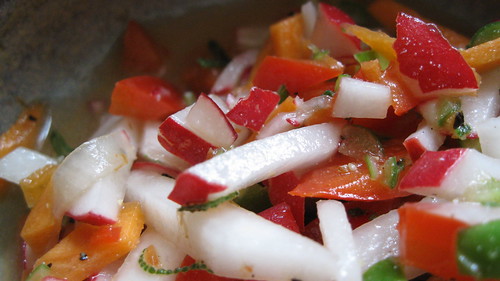
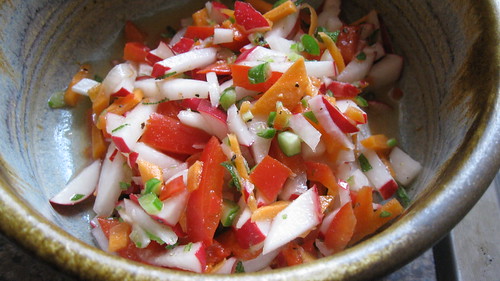
Make slaw out of them.

This recipe might not be to everybody's taste - I'm pretty easy-going, food-wise, but I'm overly picky about slaw, about water content and texture and cut and...I get excitable in diners, is what I'm saying. Also, there's no cabbage in this slaw, mostly because I didn't get any from the CSA this week, but there ARE garlic scapes in it because I did get those. Throw a little bit of garlic in it if you'd like and if you don't want to go scape-hunting, but don't overdo it.


Ingredients:

(I did this by eye - you know what slaw's supposed to look like, right? Keep adding stuff until it's the right combination of colors. I've listed the ingredients relationally with a basic idea, but your gut's probably a better guide. The recipe itself is a modification of this one from myrecipes.com.)

Salad:
1 cup Radishes, rough cut in slivers
1/3 cup bell pepper, chopped
1/2 as much of the bell pepper as Carrot, rough cut in slivers
1/2 as much of the bell pepper as Garlic Scapes

Dressing:
2 tbsp vinegar, any will do, I used Apple Cider Vinegar
1 tsp Sugar
2 leaves fresh Sage, slivered
1/2 tsp Olive Oil
1/4 tsp Mustard Powder
generous twists of Salt and Pepper

The Gist:

You can use a food processor for this, but I don't - hand-cut ingredients in slaw makes it less paste-like and less uniform. It shouldn't take long to cut your veggies by hand.

Combine the salad ingredients in one bowl and the dressing ingredients in another. Whisk the dressing and pour it over the salad. Refrigerate for 15 minutes or so and serve. The quantities above will serve 2 people as sides or 4 on sandwiches. Personally:
...I like it with bacon and muenster and a little bit of mayo on wheat.

Friday, June 5, 2009

Is That a Zucchini in Your Pocket? Thought So.

Angela and I don't see each other much during the week but I don't work Fridays, and Fridays are for dinner-for-two. Recently it's been pizza and beer because, really, who wants to cook at the end of a long week, but now that we've settled more or less into our new apartment and now that our kitchen is (comparatively) frikkin huge, I'm starting to cook again. Also, there's nothing good on TV during the summer. Ahem.

(For those of you keeping score, that was my off-hand explanation as to why I haven't posted in 6 months. Sorry about that.)

I was raised in a household were every meal was balanced, even if balance meant burgers and fries and a salad. I have very few active dislikes from the vegetable kingdom, cauliflower being the big one, the I-don't-care-how-much-cheese-you-put-on-it, I'm-not-eating-it one, and that's more of a texture issue than anything else - eating cauliflower is like chewing on brined tree bark and I want nothing to do with it.

And despite the fact that I'll eat practically anything, there are some vegetables that, for whatever reason, weren't around when I was growing up. Zucchini was one of them - I had a habit of confusing zucchini and cucumber until embarrassingly recently because, hey, they're both green and phallic and waxy and I couldn't for the life of me remember a situation where I had the two at-hand at the same time to reenforce their differences.

Laugh if you want, but I guarantee if you think about it, you've got a similar hang-up that "normal" people (not me; I'm a gentleman) think is batty.

Anyway. Summer's here, and summer means good produce, and good produce means I can throw a little of the balance that's been lacking in our diets back into the rotation.

We had zucchini in the fridge and I needed something to go along with the pork chops (Yes, pork chops. I'm still me, after all) and this:
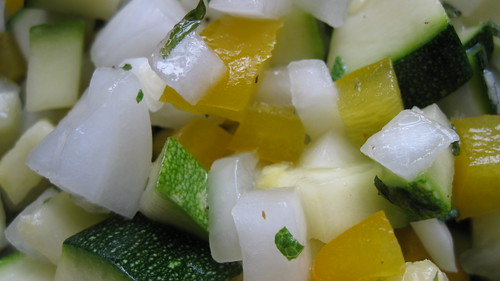
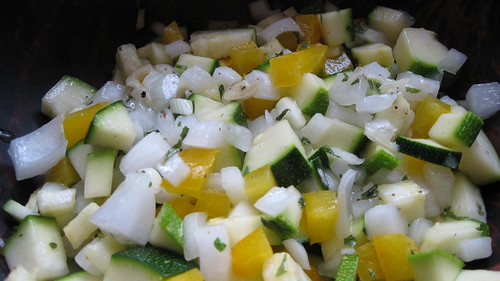
...is what I came up with. It's a zucchini salad, light and crisp and hassle-free in the extreme. It helps to have a whiskey barrel filled with herbs outside, but if you don't have any fresh green leafy things lying around, use dried ones. You're not going to be cooking this (although you can if you want to; see below) so the balance may be tricky to pull off.

Give it a whirl.

Ingredients:

1/2 zucchini, cut into bite-sized pieces
1/2 onion, chopped
1/2 bell pepper, ideally something colorful and over-sweet, chopped
1-2 cloves garlic, chopped
Juice of 1/2 lime
olive oil
Parsley, a heavy pinch or two should do
Fresh sage, 2 leaves, chopped
kosher salt and freshly ground black pepper

The Gist:

This is so simple it's ridiculous - take those ingredients, put them in a bowl, mix them up by hand and put it in the fridge for a bit. Tada! Salad.

If you're more in the mood for a warm vegetable, heat some oil in a pan, toss the salad in and cook it until the zucchini is cooked through. Or bake it. Or stir fry it. It really is a versatile collection of ingredients - it'll turn into whatever you want it to after the application of a little gentle heat.

Considerations:

I don't tend to get specific about salt and pepper, but here (like on any salad) freshly ground pepper and kosher salt make a difference - you want them to stand out instead of blending in with the background.

Tuesday, September 30, 2008

Currying favor

So I opened the cabinet to see what I could do about dinner and realized that, while we had come in under budget this week when grocery shopping, we had missed a few things. Important things like meat.

That's not strictly true, of course - the butcher's department is my favorite part about grocery shopping and a trip to the market isn't quite fulfilling without some quality time spent poking through the ground beef trying to find the elusive packages of 90% lean (perfect for burgers - 85% is too fatty and 93% doesn't have enough fat to taste like anything much) but the chicken breast we picked up I had already boiled for sandwich meat for the week (more on that in a couple of days), the shrimp vanished Saturday during a cocktail sauce experiment and the stew meat had ended up in a fantastic chili on Sunday night.

Change of plans, then - I went about seeing what I could do to clear out the fridge.

- - -

I have one memory of preschool, and that's of celery sticks with peanut butter or cream cheese in the middle. I could have sworn it was a family thing but when I mentioned it in passing to my father he steadfastly claimed to have never heard of such a thing. Despite the pleasantness of the memory, I'm not a big fan of celery unless it's served next to a heaping pile of buffalo wings or boiled to hell and back in a soup. Something about the texture rubs me the wrong way.

Why do I mention this? Guess what caught my eye when I opened the fridge - celery with an inch of life left in it, and a jar of peanut butter on its last legs. Ah well.

But then I got to thinking: Celery goes with peanut butter. Peanuts are used heavily in Thai food. Thai food leans heavily on curry. Curry is all spices and time, I've got plenty of both and I hate, absolutely hate, wasting food.

So here you go -
- a simple peanut and celery curry. It's hot enough to make your skirt fly up and it goes really, really well with a nice, slightly bitter beer (which, conveniently, I've also got in the fridge.)

I love it when a plan comes together.

Ingredients:

  • 3 celery ribs, roughly chopped
  • 1 small yellow onion, roughly chopped
  • 2-3 heaping tbsp peanut butter
  • 2 tsp salted butter
  • 1 tsp olive oil
  • 1 tsp minced garlic
  • 2 cups broth; I used chicken, though vegetable would work fine, too
  • 1 tbsp curry powder
  • 2 tsp brown sugar
  • 1 tsp cumin
  • 1 tsp chili powder
  • 1 tsp dry yellow mustard
  • 1 tsp paprika
  • 1 tsp white pepper
  • 1 tsp black pepper
  • 1 tsp dried parsley
  • 1/2 tsp tarragon
  • 1/2 tsp cinnamon
  • Salt to taste
optional:
  • 1/2 cup toasted pine nuts (I had them left over from a pesto gone wrong, so I figured what the hell)
The Gist:

Lightly brown the celery, onion, and garlic in the butter and olive oil in the bottom of a stock pot with a pinch or two of salt. Add the broth, the peanut butter, the pine nuts if you went that route, and the spices. Heat slowly over medium heat, stirring frequently, until it starts to bubble. Keep stirring for a minute or two - the peanut butter is going to take some elbow grease to mix in completely.

Once it's all combined, cover and reduce heat to low. Not medium-low; practically nonexistent low - the peanut butter is going to slowly sink to the bottom of the pot and if it's too hot it'll burn.

The longer you simmer it the better it will taste, but keep an eye on it and stir it every 15 minutes or so. It'll be done in 45 minutes, tasty in 60 and fantastic in 90.

Serve over rice. Feeds 3-4 people depending on their love of curry.

Monday, September 29, 2008

Fry me to the moon

We thew a little get together this weekend, nothing fancy - chili and beer and, once things got rolling, some deep frying action. The chili was pretty damn good but it's going to take some time for me to figure out what the hell I did, so in the interim: French fries.

Deep frying has a bad rap, deservedly so from a heath perspective, but come on. Nothing is tastier on a late spring afternoon than a burger with homemade fries.

This is my father's recipe, which is probably as simple as you can get. The equipment, however, is less standard but pretty damned important. so here goes.
You'll need a large pot with high vertical sides to keep the oil in. You'll also need a thermometer, a metal slotted spatula or metal tongs, paper towels and a small pile of newspaper or, failing that, more paper towels.

Some notes on this stuff: Cast iron is best because you're going to be heating the oil to a very high temperature and cast iron stands up to that best, though the size is more important than the material. You'll need a multipurpose kitchen thermometer - a meat thermometer won't do you any good because most of them only go up to 200-something degrees Fahrenheit and that's not gonna cut it. And you'll need a metal slotted spatula because the slots will let the excess oil out and the metal won't melt in the oil. You'll also need some frying oil (corn, vegetable or peanut, not olive. Olive oil will burn before you get it to a high enough temperature) and, I guess, some potatoes.

Skin your potatoes if you want (I don't), slice 'em how you want 'em and leave them in a bowl of ice water for 45 minutes or so - this will wick away some of the potatoes' starch and make 'em crispier when they actually go in the oil. Pour about three inches of oil into your pan, and heat it to 325F over medium-high heat. Don't crank it all the way, as you want to make sure it heats relatively evenly. You don't have to stir it, but keep an eye on it. Its temperature will rise exponentially, so start getting ready when it hits 300 degrees fahrenheit or so.

heating oil always scares me, and it damn well should scare you. It's probably obvious, but for the record (again): be careful. hot oil can cause serious damage to you, to your pets, to your children and to anything else it comes in contact with. Don't ignore it and stay clear and please, for the love of all things holy, keep your utensils clean and dry - clean so that whatever might be stuck to them doesn't contaminate the oil and dry so the oil doesn't spit when you're fishing around for the potatoes.

There are some tricks to knowing when the oil's ready if you don't have a real thermometer, but most of those, like flicking some water (or, if you're my father, spit) into the oil to see if it bubbles on contact, are imprecise or gross. Those tricks are good at telling if the oil's hot enough, but bad at telling if it's too hot - overheated oil will burn the outsides of your fries before the insides are done, and it's best to avoid that. It will also smoke, which is an eye irritant even if you can't actually see it in the air.

Once your potatoes have soaked and your oil's at the right temperature, pat them dry with a paper towel and gently slide them into the oil. They'll spit like mad, so stand back. You're going to have to do this in batches to make more than a single serving of fries, but you're not cooking them for that long and you'll get into a groove fairly quickly. Fry the potatoes for 4-5 minutes, turning frequently. When they've reached a golden-brown (which can be hard to judge right, but you'll get the hang of it) pull them out.

You're not done yet: the trick to good fries is to fry 'em twice. Crank up the oil's temperature to 375F. Once it's there, drop your fries back in for 2-3 minutes. The second frying will crisp the outsides of the fries to keep 'em from getting mushy. Pull them out and drop them into a thick rolled up cone of newspaper or into a wooden or metal (not plastic) bowl lined with paper towels. The newspaper will absorb the surface oil without pulling the oil out of the centers of the fries, leaving them moist.

Salt prodigiously and serve immediately. A potato and a half will comfortably serve one person as a side, double it otherwise. Multiply as required. And if you have a massive coronary, it ain't my fault.

(If this looks familiar, a different version of this was originally posted here.)

Monday, September 15, 2008

Vegetarian, but not snooty about it

It doesn't take a genius to realize that different people have different nutritional requirements, but you can stretch that piece of common sense in an interesting direction: it's also true that different people have different requirements to feel satiated - I love a good green salad but no matter how much of it I eat I'm going to feel less satisfied than if I had something with, say, 12 ounces of steak on it.

Angela on the other hand is a carbohydrates disposal machine - she can deal with minimal amounts of protein but try to take away her risotto and your hand will come back as a bloody stump. It actually goes farther than that with her - meat is work to her, satisfying and rewarding work, but if she's had a bad day, plopping a roast chicken in front of her will only make things worse.

Cooking vegetarian isn't something I mind doing on occasion; one of my more tasty tricks is to use spinach where you would be using something heavier, and steaming it to retain its bulk. It doesn't go so far as emulating meat like tofu can, but it does a good job of making its absence less noticeable.

This:
...does a great job of highlighting that.

Ingredients:
  • 1 cup white rice
  • 1 cup water
  • 1 cup vegetable broth
  • 1/4 pound spinach
  • 1 small yellow onion
  • 1 tsp minced garlic
  • 1/4 cup water
  • 1/8 cup olive oil
  • 1/8 cup apple cider vinegar
pinches of:
  • salt
  • pepper
  • cumin
  • celery salt
  • paprika
The Gist:

Cook the rice in whatever manner you like, but instead of using twice the volume of rice in water, use half water and half broth. Vegetable broth is fine (and vegetarian, obviously) though chicken broth works fine, too.

While the rice is cooking, lightly char the sliced onion in the bottom of a medium saucepan with a little oil. You're going to be tempted to stir it; don't. You want that lightly charred flavor because you're going to be steaming it after this and you don't want all of the flavor to leech away.

Once the onions char (10 minutes or so; don't overdo it) put the spinach in the pot with the garlic and 1/4 cup of water. Wait for the water to boil, cover, and reduce heat to a simmer. Cook until the spinach is tender but still retains its liquids, about 8 minutes, give or take.

Serve with a drizzling sauce made up of the olive oil, vinegar and spices.

Prepared this way, it will serve two, though it doubles easily.

Monday, September 8, 2008

Culinary Transparency

The best thing about Chinese takeout, at least the kind found on almost every street corner in New York City, is that you're never more than 15 feet from your food, usually in a direct line of sight with it, as it's being cooked. It's the pure transparency of the thing that gets to me - restaurants with open kitchens are a comparatively new and trendy thing in the world of haute cuisine, but it's old hat to me. I'm not sure what does it, but food tastes better when you can watch it being prepared.

I've always been fascinated by how so few ingredients can make something so incredibly tasty as, say, fried rice, to the point where I sometimes get a craving that can be sated by four hours on a bus and nothing else.

I haven't done it on a whim yet, but don't tempt me.

At home, you can't beat a quick stir-fry for ease of preparation, but my only real problem with throwing a bunch of stuff into a wok and dizzying it up with a wooden spoon is how tired I get of the finishing sauces after awhile - most of the Chinese takeout sauces the American palette is typically familiar with and have easy access to fall into the rather generic collection of Sweet, Hot, Garlicky or (for lack of a better descriptor) White. It makes selecting from a menu easy (you identify a craving and run with it) but it doesn't do much if you're looking for a little subtlety, though to be fair I guess that's what I get for being cheap.

The sauce this recipe creates is a bit confusing until you get used to it - it's hot enough to clear out your sinuses, then garlicky at the back of the mouth before rounding out as sweet. I've included directions for this:
...a generic chicken stir-fry, but the sauce is the point. It's truly wonderful in its versatility - apart from being wonderful in a wok, it's great as a salmon glaze, as a chicken wing sauce (I can't recommend this enough, particularly if the wings are tossed lightly in sesame seeds as a finish) or as a salad dressing.

Sauce Ingredients:
  • 1/4 cup soy sauce
  • 2 tbsp butter
  • 1 tsp minced garlic
  • 1/2 tsp Huy Fong-brand hot chili sauce for spicy, 1 tsp for hot
  • 1/2 tsp brown sugar
  • 1/4 tsp ground ginger
  • 3 dashes black pepper
  • 2 dashes paprika
  • 1/2 dash white pepper
  • chopped scallions
Stir-Fry Ingredients:
  • base ingredients - I used a chicken breast, a handful of snow peas and a quarter onion
  • 1 tbsp vegetable oil
  • 1 tsp minced garlic
  • Heavy dash of soy sauce

The Gist:

Combine the sauce ingredients in a small saucepan over low heat, stirring occasionally, until it bubbles.

Heat the oil in a slope-sided pan until spitting hot. Add the stir-fry ingredients and stir constantly until cooked through. Take off the heat when finished, drain any excess liquids and return it to the pan over medium heat.

Pour the sauce over the stir-fry and toss to combine (don't burn the sauce). Serve over rice.

Considerations:
  • Huy Fong-brand Thai chili sauce is a truly amazing sauce that I'd recommend you keep a bottle of on-hand, but tolerances for it vary by the individual; try it out before you commit, and add it slowly.

Thursday, August 14, 2008

Wok Me Like A Hurricane


Let's face it: most of the time, fried rice is the second half of a cheap Chinese takeout combo meal used to validate charging you an extra three bucks when, if you had stopped and thought about it beforehand, you would have realized that all you really wanted was an egg roll with your moo goo gai pan. It's an afterthought.

If it's done right, though, right the way Chen Kenichi does it, fried rice is a ballet, a collection of textures and flavors simultaneously working together and fighting with each other - gooey enough to be lifted with chopsticks, light enough to avoid feeling greasy, and spicy enough to singe your eyebrows.

Chef Chen makes it look easy and it's easy to describe with words, but honestly I've never had fried rice that good in my life. Not even close.

The concept of fried rice, though, is a fundamentally sound one, and one you can apply to less austere, more utilitarian (and less Chinese) dishes - take some day-old rice you don't want to go to waste, heat it up in a pan with some oil in it, add some vegetables and call it a carbohydrate.

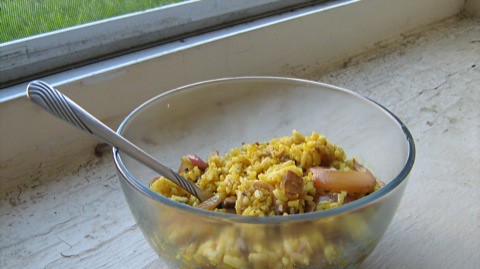
This:
is one example that happens to work excellently as a side dish, just like its forefather, but a side of a different sort. If you'd like to use it as a main course, double it. Oh, and don't be scared by the vanilla - it's used purely as an aromatic and won't appear in the finished dish as anything more than a pleasant background note.

Ingredients:

  • 1/2 cup cooked brown rice (fresh or day old, but day-old is actually tastier)
  • 1 red onion, roughly chopped
  • 4 white mushrooms, chopped
  • 2 tbsp olive oil, 1 tbsp at a time
  • 1/2 tsp minced garlic
  • 1/2 tsp turmeric
  • 1/4 tsp vanilla extract
  • Salt and Pepper

The Gist:

If you don't have any leftover rice handy, make some. The method is up to you - I have a rice cooker, but a pot on the stove with some water in it works fine, too.

Combine everything but the rice, the turmeric and 1 tbsp of the olive oil in a bowl and let it sit at room temperature while you heat a pan over medium-high heat.

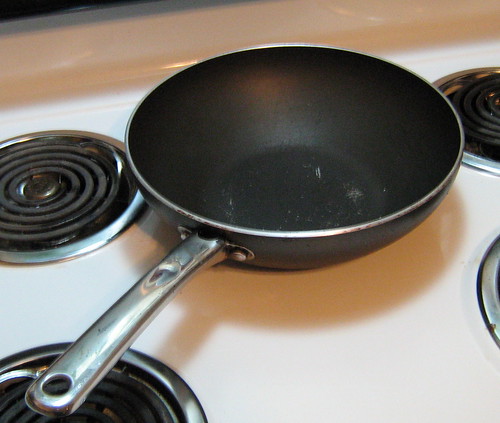
Speaking of pans: do you have one of these?
A slope-sided, flat-bottomed pan will make cooking this easier - while it's totally possible to do it in a frying pan, a wok pan will keep the oil hot, make the rice easier to move around and help you not get food all over your stove-top.

Anyway. Once the pan is hot, add the vegetable mixture. Keep it moving so it doesn't burn, and cook until the onions soften and the mushrooms brown. It should take 5 minutes or so. Pour the vegetables into a bowl and rinse out your pan.

Add the second tbsp of oil and heat it up to medium again before adding the rice and the turmeric. Keep moving the rice as you did before with the vegetables for 5 minutes or so before adding the vegetables back to the pan. Work them together and get them off of the heat before it burns.

Eat up! I made this as a side for pork chops and peas and it was fantastic. I'm sure it would work great as a main dish tossed with shrimp or ham, as well.

Mmm. Ham.


Considerations:

  • Turmeric, though tasty, will turn everything it touches (your hands, your stove, your pets) a frightening shade of yellow. Try not, as I did when I cooked this, to pour it while standing under the influence of a ceiling fan. (oops)
  • Stir-frying with olive oil is usually a bad idea - while it's more flavorful and healthier than its cousins, it also starts to smoke and at a much lower temperature than, say, canola or peanut oils do. To that end, you don't want the heat to go any higher than a tick over medium. You can get away with it here, though, because nothing you're going to be cooking is going to kill you if it isn't cooked through; just don't try this with chicken.

Serves 2 as a side dish or 1 as a meal. It doubles, but only up to a point - any more than double this recipe and you might have to cook it either in a stock pot or in shifts.